
If you run a brick-and-mortar business, you already know that you are legally and ethically required to make your physical space accessible to everyone. You install ramps, widen doorways, and ensure anyone—regardless of physical ability—can enter your premises and buy from you.
But did you know the exact same rules apply to your website?
In the digital world, this is known as Website Accessibility. It is governed by a global set of standards called the Web Content Accessibility Guidelines (WCAG). Unfortunately, many business owners treat digital accessibility as an afterthought or a boring IT checklist.
In reality, web accessibility is one of the most critical legal, ethical, and business topics today. Here is exactly what WCAG is, and why ignoring it is a massive risk to your bottom line.
What is WCAG, Anyway?
The Web Content Accessibility Guidelines (WCAG) are the international gold standard for making web content more accessible to people with disabilities. This includes individuals with visual impairments (like color blindness or total blindness), hearing loss, motor difficulties, and cognitive limitations.
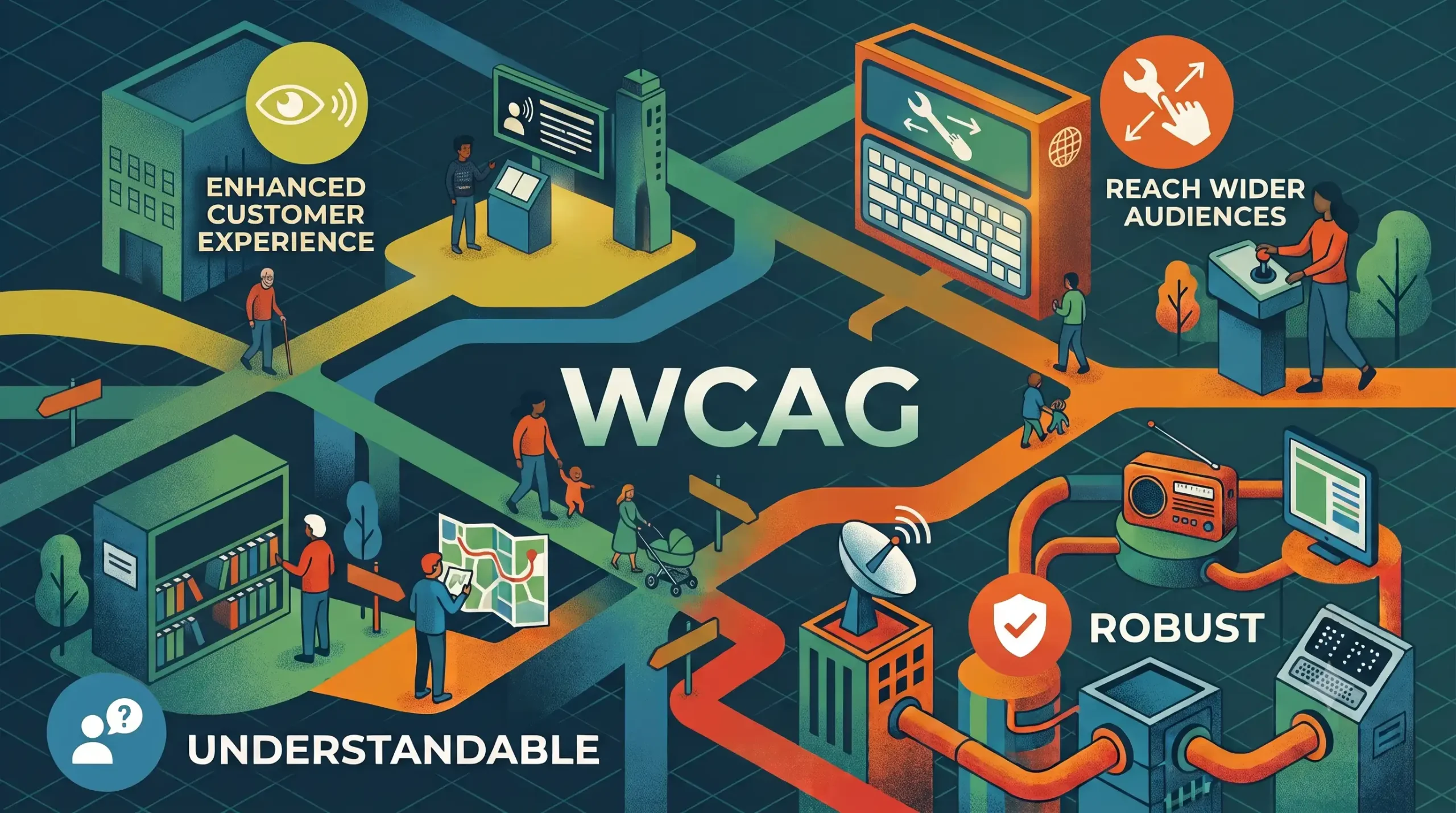
WCAG breaks down accessibility into four core principles, often referred to as POUR:
- Perceivable: Users must be able to comprehend the information on your site. (e.g., providing text alternatives for images so screen readers can describe them to blind users).
- Operable: Users must be able to navigate the site. (e.g., ensuring someone who cannot use a mouse can navigate your entire website using only a keyboard).
- Understandable: The content and user interface must be clear and easy to follow. (e.g., error messages that clearly explain how to fix a mistake in a contact form).
- Robust: Your website must work reliably across different technologies, including assistive devices like screen readers.
Why Your Business Cares: The 3 Main Pillars
Making your website accessible isn’t just about doing the right thing (though that is a massive part of it). It directly impacts your legal safety, your search engine rankings, and your revenue.
1. It Protects Your Business from Costly Lawsuits
Digital accessibility lawsuits have skyrocketed over the last few years. Courts around the world are increasingly ruling that the law protects internet access just as much as physical access.
- The Risk: If a user with a disability cannot navigate your website, read your menu, or check out from your e-commerce store, your business can be hit with a costly lawsuit. Small businesses and massive corporations alike are being targeted by predatory legal claims over non-compliant websites.
- The Solution: Building your site to align with WCAG standards serves as a powerful shield, protecting your business from legal vulnerabilities and expensive settlements.
2. Accessible Design Supercharges Your SEO
Here is a poorly kept secret in the tech world: Google navigates websites the exact same way a visually impaired user does. Google’s search bots cannot “see” images or videos; they rely entirely on the underlying code and text structure to understand what your website is about.
- The SEO Boost: When you optimize your site for accessibility, you are accidentally optimizing it for search engines. Adding descriptive alt-text to images, using clean header hierarchies (H1, H2, H3), and providing video transcripts give Google more data to index.
- The Bottom Line: An accessible website ranks higher on Google, leading to more organic traffic and more leads.
3. You Open Your Doors to a Massive Market
When your website isn’t accessible, you are essentially turning away up to 20% of the population. Millions of people navigate the web daily using assistive technologies.
- The Revenue Factor: If an e-commerce site or service page is impossible for a disabled user to navigate, they won’t struggle through it—they will simply leave and spend their money with a competitor whose site is accessible. By adopting WCAG standards, you immediately expand your market reach to a loyal, underserved demographic.
Don’t Wait for a Legal Notice to Fix Your Site
Website accessibility can feel incredibly technical and overwhelming, but it is no longer optional. It is a fundamental requirement for doing business online. Ensuring your site meets WCAG standards protects your brand reputation, insulates you from legal headaches, and ensures every single visitor has a great experience.
At iSeek, we build websites with accessibility baked right into the foundation. From color contrast and keyboard navigation to clean, semantic coding, our design and development team ensures your digital presence is beautiful, high-performing, and fully compliant.
Is your website legally compliant and accessible to all?
Let’s audit your current site and build a web presence that welcomes everyone.